|
 |
Events
- Networking is considered to be one of the key
skills for gaining visibility in academia – and yet
many female researchers find it difficult. The
(German) workshop
series “Networking for female Researchers”
addresses precisely this need. The first workshop
will take place on 21 April on 18.00h in the
Auditorium Haus "Zur Rosen" (Johannisstr. 13). You
can register for it until 14 April.
- The main welcome
event for new staff and researchers at
the University of Jena will take place on 29 April.
At the event, new staff and researchers will have
the opportunity to learn about the university's
various units and then mingle over coffee and cake.
Registration is open until 15 April.
- Are you thinking about leaving academia after
completing your PhD? In the (English) Online
Alumni talk ?From Academia to Industry“
on 5 May, three STEM alumni, share their experiences
with the transition from academia to industry and
will give advice on application processes, career
development and working outside of academia.
- How does an idea turn into real impact? This will
be discussed and demonstrated at the event ‘Set
up: Jena 2026 – From Idea to Impact’. It
will offer a marketplace for projects and services,
parallel workshops and a networking lounge. The
event will take place on 7 May from 14:40h at the
Normannenhaus Jena.
- There are still too few women in academia. What
are the reasons for this? This will be discussed at
the evening
talk ‘Women in Academia’ on 13 May at 6
pm in Lecture Hall 3. The talk will cover, amongst
other things, gender stereotypes in everyday
academic life, the Academic Employment Law, and
balancing family life with an academic career.
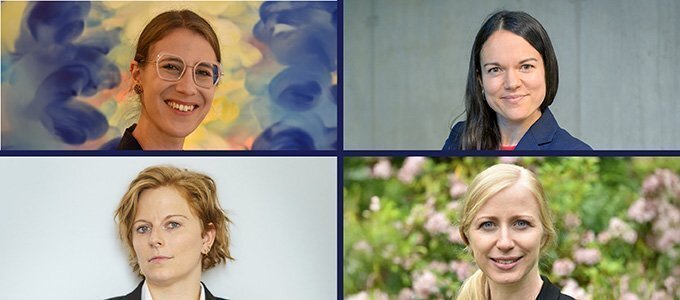
(Pictures above: University Jena (2x), Susanne Kurz,
Frederik A.)
More upcoming events:
Conference ?Creating
the Digital Academy – Perspectives & Reflections
on Digital Research“ +++ Online
Coffee Lecture on Research Data Management +++ FxCKUp
Night Jena +++ Diversity
Day +++ Forum
Digital University
|
|
|
 |
Get
involved
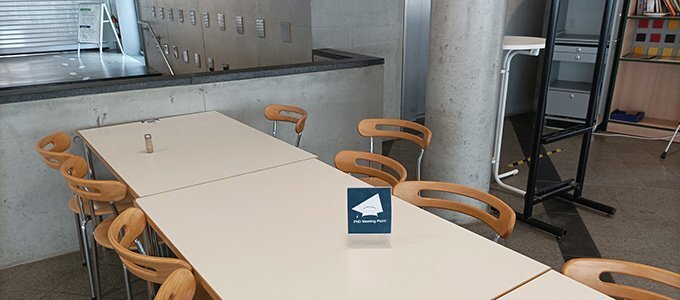
- Finally a doctoral candidate, but suddenly alone
among undergrads in the cafeteria? To help with
this, the doctoral council will establish a meeting
spot for doctoral candidates in the Ernst-Abbe
Mensa. You can find the table next to the
elevator, above the staircase (see picture above) on
every Thursday around 13:00h. If you want to play it
safe and make sure you’re recognized as a doctoral
candidate, you can use the new app developed by the
doctoral council (see next message).
- DR.FSU has developed an DR.FSU app that
keeps doctoral candidates informed about upcoming
events and also includes a search function for other
doctoral candidates in the dining hall (see above).
The app works by manually selecting your location
inside or in front of the cafeteria and transmitting
it to the room via Bluetooth (BLE). The app does not
use GPS, servers or tracking. It is open-source and
can be downloaded here.
- The photo
competition "Hats off!" will take place
again this year. In this competition the most
beautiful, self-made doctor hats will be awarded.
Photos of the hats can be submitted until 10 May. At
the beginning of June, you can vote for the photos
online. The awards will be given at the Schiller
Day.
|
|
|
 |
Qualification
offers
There are still vacancies in the following online and
on-site workshops:
- Graduate Academy:
- Lehre Lernen:
- Digital research services:
- Project "Gender in focus":
- EC2U network:
|
|
|
 |
Announcements
- The Thuringian Competence Network for Research
Data Management (TKFDM) is once again awarding the FAIRest
dataset in Thuringia. Researchers at
Thuringian universities can win up to �2,000 by
submitting a published dataset that complies with
the FAIR principles (Findable, Accessible,
Interoperable, Reusable).
- The universities of the Coimbra Group are offering
short-term fellowships for international
researchers from neighbouring
European countries, Latin
American countries and sub-Saharan
African states. The fellowships are awarded
for a period of one to three months. The University
of Jena is a member of the Coimbra Group.
Application deadline is 10 May.
- The Fraunhofer Institute for Applied Optics and
Precision Engineering IOF is inviting entries for
its Early
Career Award for the best bachelor’s,
master’s and doctoral theses. The prize is worth up
to �3,000. The deadline for applications is 30 June.
- The Fast
Forward Science competition recognises
the best scientific social media posts. Early-career
researchers have until 30 April to submit their
entries in the various categories. Eligible entries
include YouTube videos, podcasts, and Instagram
Stories that make current research accessible to a
wider audience. The prizes are worth a total of
�9,000.
- The European Commission is looking for PhD
candidates and postdocs to take part in the five-day
science
competition “EU TalentOn” in Brest
(France). In this competition, they will work
together to find innovative solutions to some of the
world’s biggest challenges. Participants will
benefit from an intensive programme including
coaching, workshops and networking activities. There
is a total of �80,000 in prizes to be won.
|
|
|
 |
This
may be of interest to you
- In March, an open
letter was published calling for a moratorium
on the development of so-called superintelligence.
The letter has already been signed by more than
100,000 people. Prior to this, 145 German professors
had drafted an appeal
calling for the introduction of red lines in the
development of AI. This was prompted by a global
AI summit in Delhi, which took place in
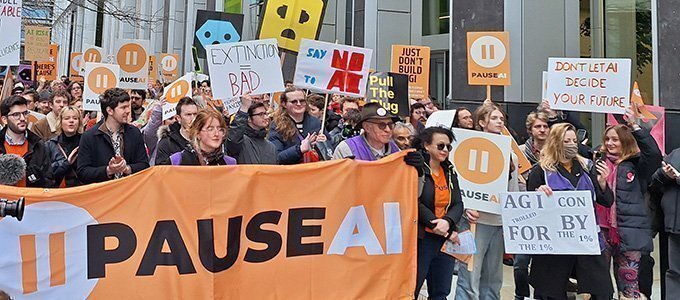
mid-February. The appeal is part of the global ‘Pause
AI’ initiative (see picture). The idea of red
lines goes back to an open
letter published on the occasion of the UN
General Debate on AI in September 2025.
- A new
study has examined the health of
university professors in Germany. Over 2,000
took part in an online survey. On average, the
respondents work around 54 hours a week and suffer
from mental exhaustion (60 per cent), sleep
disorders (46 per cent) and physical exhaustion (38
per cent). Eight per cent have experienced burnout
in the past six months. At the same time, 44 per
cent of professors say they are satisfied or even
very satisfied with their work situation.
- A team of international researchers has now examined
the use of humour at scientific conferences.
The study analysed 531 presentations at 14
bioscience conferences. They found that male
researchers and native English speakers are more
likely to feel confident enough to tell jokes than
female researchers. Jokes are most commonly used as
ice-breakers at the beginning or (particularly by
PhD candidates) at the end of a presentation, once
the tension has subsided. Very few researchers feel
confident enough to tell several jokes in a single
presentation. The use of humour creates a stronger
connection between the speaker and the audience. But
don't expect too much: Two-thirds of all jokes
elicited only a mild chuckle from the audience.
- Several interesting podcasts have now
emerged, focusing on developments in the global
academic system: for example, “Everything
Hertz”, “Two
Psychologists Four Beers” and “Nullius
in Verba”. The German academic system in
particular is explored in the podcasts “Nachwuchsfragen”
(in German) and “Chances
and Challenges – The BGHS Podcast”. Meanwhile,
the Jena-based podcast “Mensch
im Blick” explores the topic of gender in
research (in German).
|
|
|
 |
News
from University of Jena
- From April, university
employees' salaries will rise by 2.8 per cent.
This is the result of the collective
agreement reached in mid-February. A further
increase of 2 per cent will take effect from 1 March
2027, and a further 1 per cent from 1 January 2028.
The agreement is valid until 31 January 2028.
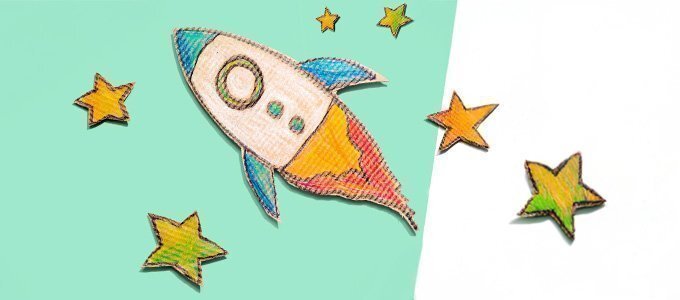
- The Family Office
at the University of Jena is once again announcing
its Unikate
painting and craft competition (see
picture above). This year’s theme is ‘Imagination
explores new worlds’. Children of university staff
can submit their paintings or craft projects until
29 May.
- On the roof of
the Thuringian University and State Library (ThULB),
a new photovoltaic system has
been installed. Since mid-February 2026, it
has been generating electricity to meet the
building’s own needs (around 125 kilowatts peak). In
the foyer, the system’s current output, daily yield
and current CO? savings are displayed.
- Manja Marz, a
professor of bioinformatics at the University of
Jena, is the new amateur world champion in the
strategy game ‘Go’. The multiple German Go
champion won
the title in Tokyo in mid-March. Marz intends
to invest the prize money in special Go boards for
iIndividuals with visual impairments. She has long
been committed to promoting the game of Go in Europe
and, among other things, founded the only (offline)
Go school in Europe.
|
|
|
 |
Latest
News from Jena
- An ‘Energy
Lab’ has opened in the former Stadtlab
(L?bderstra?e 6), demonstrating how the shift to
renewable energy can be accomplished in Jena.
Among other things, the exhibition presents the
results of a representative survey of Jena’s
population on the transition to renewable energy, as
well as detailed graphics about the planned virtual
power plants in JenaWohnen’s
test neighbourhood. The exhibition also
includes an installation
at Engelplatz: there, a walk-on map of
the city covering around 100 square metres shows
where the energy supply of the future is already
being implemented within the city today.
- From June 2026, Jena's largest leisure
swimming pool, GalaxSea, will close for a year
and a half. The pool is to undergo
renovation to improve its technical and energy
efficiency. In addition, a new indoor adventure
world shall be created, where children can dive into
colourful underwater worlds with virtual reality
glasses.
- The city of Jena wants to track how residents
move around the city. To this end, the
Smartcity project installed
various monitoring systems in March on
Johannisstra?e, at Kirchplatz and on the market
square: these systems use Wi-Fi data, laser pulses
or radar waves. The anonymously collected data is
intended to provide insights for future urban
planning. The Thuringian town of Mühlhausen is
already using a similar system to track passers-by
and displays the data via a dashboard.
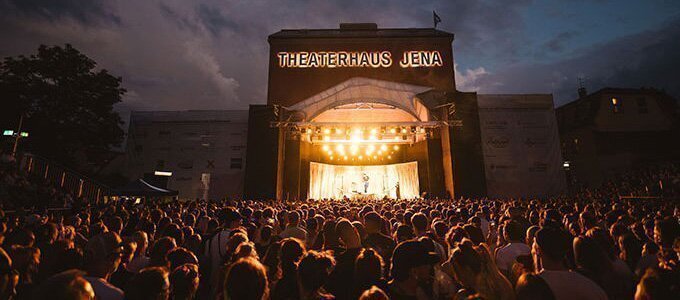
- If you already want to get a bit of summer
feeling, you now can buy tickets for the Kulturarena.
The Kulturarena
Jena is a six-week festival that takes place
annually in July and August and offers a mix of
concerts, theatre, cinema and children's events.
(Picture above: Christoph Worsch)
|
|